What does it take to build trust?
Reflections from a week at the county fair

Over the past week, I’ve been spending most of each day at the county fair. In 4-H, my kids have been working on their projects the whole summer. And in some cases, longer than that.
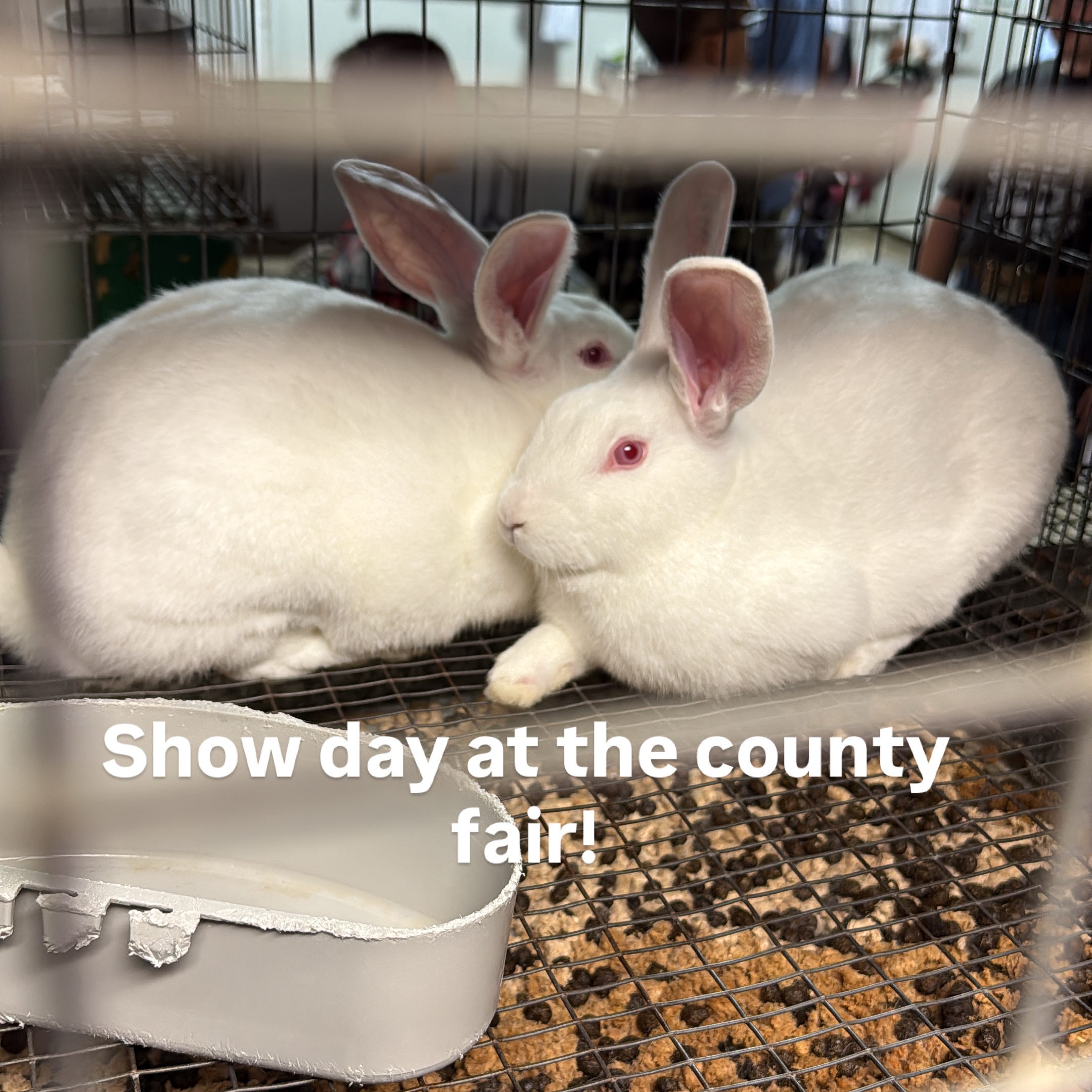
We’ve got a breeding rabbit that is a couple of years old at this point.
In 4-H, you’ve got to trust the process. There’s no way to rush time. The rabbit has to be a certain age to qualify. This means that there are set periods for everything. Technology taught me the opposite—that anything worth building should happen faster. Only now do I see how much wisdom lives in waiting.
There’s a time to start the breeding process. There’s a time to sell the baby bunnies to compete in other county fairs. (There are some rules about where you can raise and show or maybe it’s just avoiding competition from your own offspring. Still not 100% on that, and enjoying that fact immensely.)
And every year, a few families walk away with the majority of the trophies. And something I noticed this year is that everyone was talking about how bad a year it was to raise rabbits. But if everyone is having a bad year, guess who still wins?
Still the same few families.
But I saw something that I can’t get out of my head. There’s an event that the kids can enter called “Showmanship”. The goal of the event is to demonstrate mastery of your animal and your knowledge of their species. We are talking listing breeds, diseases, anatomy, breeding, everything about everything is on the table.
And if you win your age group, you go against all ages from your species. This is called Showman of Showman. And the Showman of Showman goes on to compete for Super Showman.
Super Showman is awesome and is something I checked out for the first time.
Imagine a big arena with 9 stations. At each station, there’s a different animal. There’s a rabbit, a pig, a steer, a horse, a goat, a turkey, a sheep, and a couple of other animals.
Then, the kids have to go around and demonstrate mastery of every animal there.
During this show, I spent most of the time talking to the mom of a girl in my sons’ club. She’s the same age as my older son, and she was there to award the Super Showman award, because she won it last year. And when you win it, you can’t win it anymore because there’s only so many years. They like to leave it for other kids to win.
But when you top out at 14, where do you go? As it turns out, coaching. Since she couldn’t win again, she put all of her energy into helping other kids learn how to do better with their animals. I had the pleasure of capturing a video of her helping some kids in the rabbit barn handle their animals while my kids were working on theirs, and after she left, the girls she was helping couldn’t stop raving about how amazing she was.
In 4-H, there’s a clear progression of winning. The trust is established in the competition. But if you listen to the rumblings in the barn, there are always complaints about the same families winning everything. There are accusations of cheating that get lobbed around, and all animal cages are locked at all times.
That’s why the competition works. There’s a trusted competition that has judges evaluate the work and tell the audience how valuable it is. And the market takes that as reality.
We're going into the fair for the auction today. My younger son won the best overall market pen of rabbits, and gets to sell first. I’ve never attended the auction before. I’m excited, because this is a weird case where the value isn’t the actual product, but the person. The local businesses decide to bid on animals to reward the champion 4-Hers for the work they put in. Last year, I think my kids made about $1500 combined. There’s a chance that my son’s single pen could go for $2000-4000 this year.
I’ve been doing some writing around the idea of conscious markets and this is something that I think captures this idea perfectly. The market price isn’t about paying the kid for the rabbits today.
It’s about paying the kid and getting them excited to continue working with animals. Why wouldn’t you want the best being the ones who are the ones who end up taking it to the natural conclusion? Working in agriculture. And when you look around, you see the same families having worked in agriculture for generations. That’s how my kids do well at the fair. My wife and her sister were huge into showing. Their mom raises sheep. It’s knowledge passed down from family to family. And that’s what determines the future generations’ successes and/or failures.
When I see this, and then I look at the internet, I see a bleak future for it. Or at least, most of it. The parts created by Silicon Valley, because they have an inflated sense of worth. When I saw how deeply the people around the fair understood the world, because they live in it, I realized that Silicon Valley doesn’t have a sense of grounding. The people in Silicon Valley are escaping their pasts. Looking for a brighter future. That’s the narrative Silicon Valley has given us. But at what cost?
Our brightest minds are going to develop fancy slot machines with crazy names like “Candy Crush”. Or “Claude”.
I’ve spent 5 years exploring the ideas of trust online, but haven’t been able to actually establish any. There hasn’t been a ranking system that allows us to evaluate the actual learning that happens, only the ability to make money with it.
I’m incredibly good at learning. And incredibly bad at making money with that learning. But I’m continuing to figure it out, because I don’t have a choice.
And I realized that I don’t want to make money with tech. Even though that’s where I’ve got ultimate leverage, because I know how to build enterprise level systems, I realized that enterprise level systems are what caused the problems in the first place. I have to give up the leverage I’ve built because of the way the internet is designed. Everyone wants me to help them figure out their insane complex ideas because I’m good at it. But only the people who can’t make money with them, because that’s the hard part.
Watching the auction today, I realized the fair runs on a rhythm that Silicon Valley forgot. Nothing here scales overnight. Rabbits are bred, children grow, knowledge passes quietly from one generation’s calloused hands to the next. Trust accumulates like soil—layer on layer of attention, patience, and repetition.
Silicon Valley, for all its genius, keeps mistaking acceleration for progress. It burns through people the way a field burns through crops—harvesting brilliance, then salting the ground. Each new cycle elevates a few, exhausts many, and erases the memory of how things were built. There’s no lineage in that; only power structures that fade faster than they can be understood.
Maybe the next real innovation isn’t faster code or bigger valuations, but continuity—the slow inheritance of wisdom. The fair teaches that value can’t be manufactured or optimized; it has to be raised. If we ever hope to build technologies worthy of trust, they’ll have to grow the way good stock grows: season by season, taught by people who remember why it mattered in the first place.